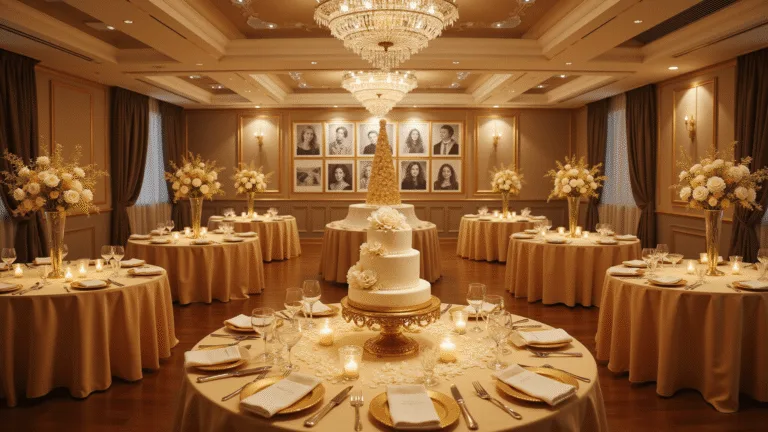
Round Table Wedding Decor: What Actually Matters When You’re Planning Yours
Round table wedding decor is where most couples either overspend on flowers nobody will remember or underspend on the details guests actually notice — the napkins they unfold, the candle they lean past to talk to someone, the table number they squint at from across the room. I’ve sat through a lot of reception planning meetings, and the round table conversation almost always starts in the wrong place: centerpieces first, everything else as an afterthought. I’d rather start with what the table needs to do.
A round table is a stage for conversation. Everything on it — linen, charger, glassware, flowers, candles — either supports that or gets in the way. Good decor coordinates with the ceremony design, the lighting, the stationery, the whole shape of the day. But the test I keep coming back to is simple: can the people sitting there see each other, reach the bread basket, and not knock a votive into the gravy? If the answer’s no, the design needs rethinking, however lovely it looks in the mock-up photo.
What Round Table Wedding Decor Actually Includes
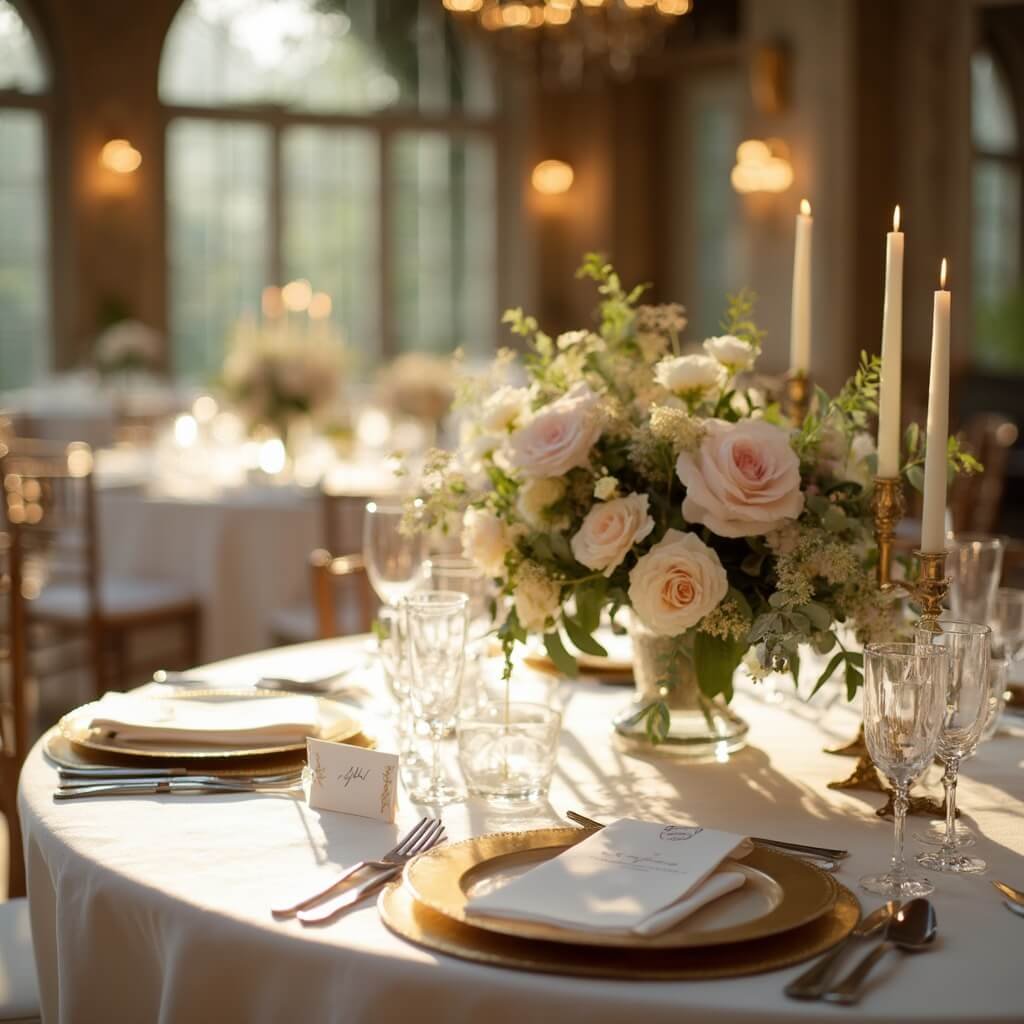
When people say “table decor” they usually mean flowers. It’s much more than that. You’re coordinating linens, chargers, dinnerware, flatware, glassware, napkins, menus, place cards, table numbers, centerpieces, candles, and the chairs themselves — a dozen small decisions that need to feel like one decision.
The trap is treating these as separate shopping trips. Chargers chosen in isolation from the napkin colour. A centerpiece that’s gorgeous but was never tested against the actual plates the caterer uses. I always tell couples: pick your overall tone first — romantic, rustic, minimalist, whatever — then let every tabletop choice answer to that tone. It keeps you from ending up with a table that looks like it was assembled from three different Pinterest boards, because it was.
Comfort matters just as much as composition. Guests need to reach their drinks without leaning around an arrangement. Servers need a clear run at the plates. Nothing should dangle into someone’s lap or block the person opposite from being seen. I’ve watched a bride spend four hundred pounds on a floral installation so tall it meant her own grandmother couldn’t see her from the next table over. Lovely centerpiece. Bad decision.
Why Couples Keep Choosing Round Tables
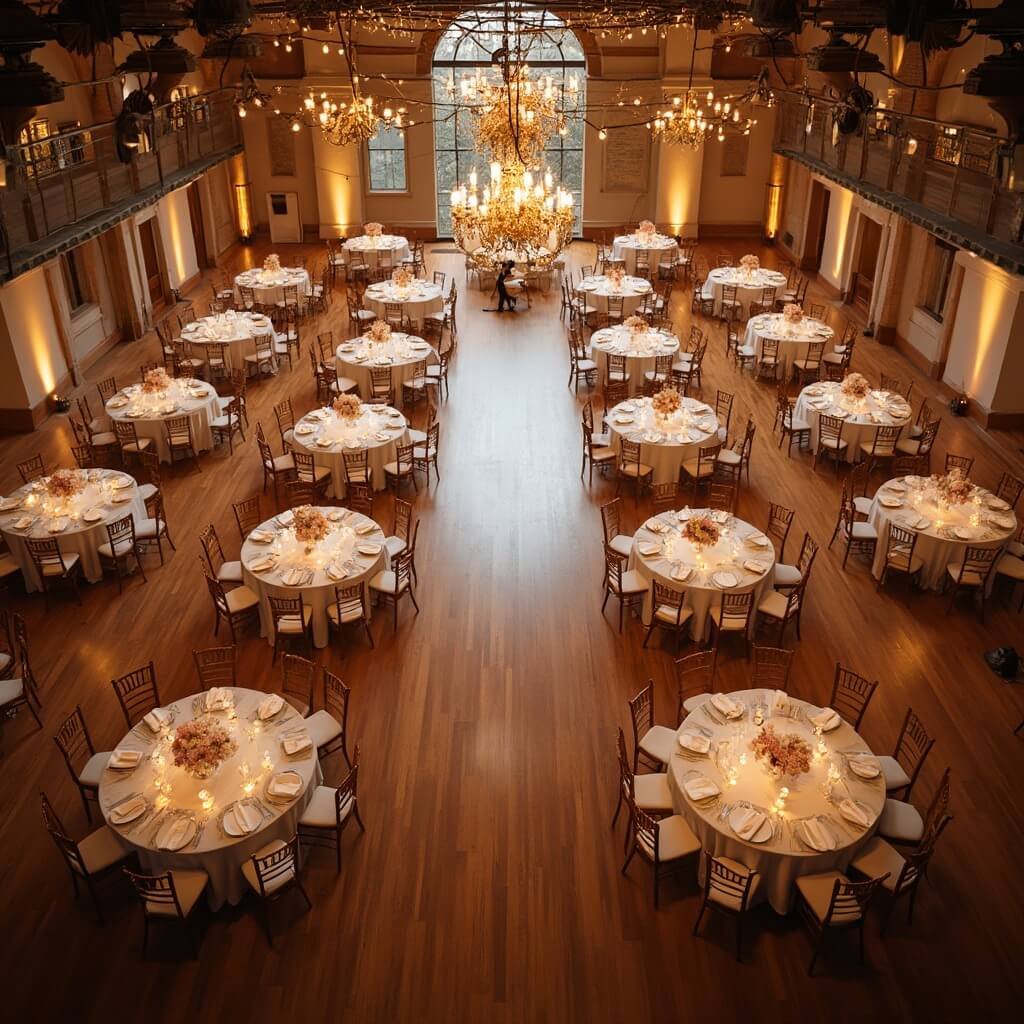
Round tables remain the default reception shape for good reason. Everyone at the table can see everyone else — no one’s stuck at the far end of a long banquet run, shouting over three other conversations to be heard. That shape does real work for atmosphere. It’s harder to feel isolated at a round table.
They’re also flexible. A round table styled with linen and one composed centerpiece can carry a minimalist look just as easily as a maximalist one — rustic, garden, modern, glamorous, eclectic, it bends to whatever you’re building. Venues like them too, because rounds of eight to ten guests are a standard reception format that balances conversation with efficient use of floor space.
That said, rounds aren’t without downsides, and I think couples get sold on them without hearing the trade-offs.
- Very large rounds — twelve-plus guests — can split into two separate conversations rather than one shared table, which defeats the point
- Centerpieces, chargers, and shared serving dishes eat tabletop space fast, especially on smaller rounds
- In a long, narrow room, rounds can actually waste more floor space than rectangular banquet tables
- More tables means more centerpieces, more linens, more table numbers, more setup time — the multiplication effect catches people out in the budget
None of that means skip round tables. It means go in with eyes open about what you’re trading for that lovely, inclusive shape.
Design Principles Worth Following
Proportion is the one people get wrong most often. The centerpiece has to match the table’s scale — too small and it disappears on a 72-inch round, too large and it swallows the space meant for plates and glasses. I always ask florists to do a full mock-up on the actual table size before signing off, not a sample on a trestle table in their studio.
Repetition with variation keeps a room from feeling either chaotic or sterile. Repeat your colour palette, your candle style, your vessel material across every table — but let the flowers or the table number design shift slightly table to table. Identical centerpieces at every table can look strangely corporate. All different, and the room loses cohesion. You want the eye to recognise a pattern without being bored by it.
Think about layering as building up from the table surface: linen, then charger, then the place setting itself, napkin, stationery, centerpiece, and finally whatever light source sits on top. Each layer should earn its place. And leave negative space — don’t let the design instinct to add more override the practical need for guests to actually use the table. Even a maximalist, jewel-toned, candle-heavy design needs clear patches of tablecloth showing through.
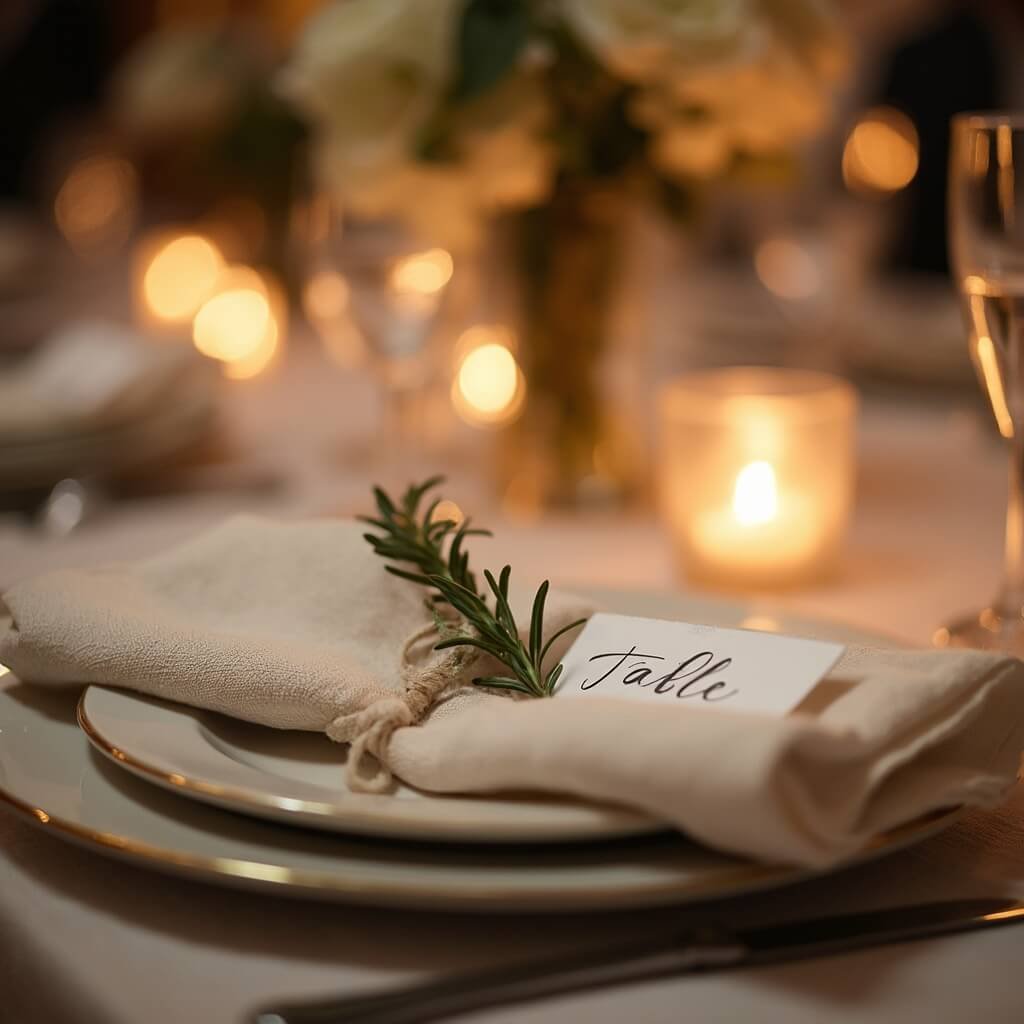
Design for the guest’s experience, not just the photograph. Sightlines to the top table, room for a handbag, enough light to read the menu — these things rarely show up in styled shoots, but they’re what guests remember, even if only unconsciously.
Getting Table Size and Seating Right
This is the bit couples skip past fastest and regret latest. Round tables come in a handful of standard diameters, and the difference between them changes everything else about your styling.
- 36–48 inches: intimate, two to four guests — sweetheart tables, small cocktail setups
- 54–60 inches: the workhorse size, generally six to ten guests
- 72 inches: ten to twelve guests depending on chair width and whether you’re doing plated or family-style service
- Larger than that: possible for big groups, but conversation suffers and centerpieces need real thought
A 60-inch round comfortably seats eight, and can stretch to ten if you’re not fussed about elbow room. A 72-inch round can take ten to twelve. Don’t assume — ask your venue exactly what they mean by those measurements. Is that the tabletop diameter or the total footprint once the linen’s draped? Are the tables folding, pedestal, or specialist rentals, because linen sizing changes depending on which. I’ve turned up to a rehearsal where the “60-inch rounds” turned out to be 66 inches once you measured properly, and every single linen order had to be redone two days before the wedding. Not a disaster, but an entirely avoidable headache.
Guest capacity should start with your meal format, not an arbitrary number. Plated meals need more space per cover than a relaxed buffet. Family-style needs room in the middle for serving bowls, which quietly steals space from your centerpiece plan. Buffets let you seat slightly tighter, but then you need wider aisles for people queuing and circulating.
My rule of thumb: don’t put more than ten to twelve at a round if you actually want people talking to each other rather than just the five nearest them. To work out table numbers, take your total guest count, subtract anyone on a sweetheart or top table, divide by your chosen seats-per-table, and round up — always up, never down, because an overfull table is far worse than an empty seat. Build in a little slack for last-minute additions, a wheelchair user who needs extra clearance, or the florist’s invoice assistant who somehow always ends up staying for cake.
For more ideas, check out our minimalist wedding table decor ideas or get inspiration from our simple wedding table decor inspiration.
👇Shop the Look Here👇
Clearance, Traffic, and the Floor Plan Itself
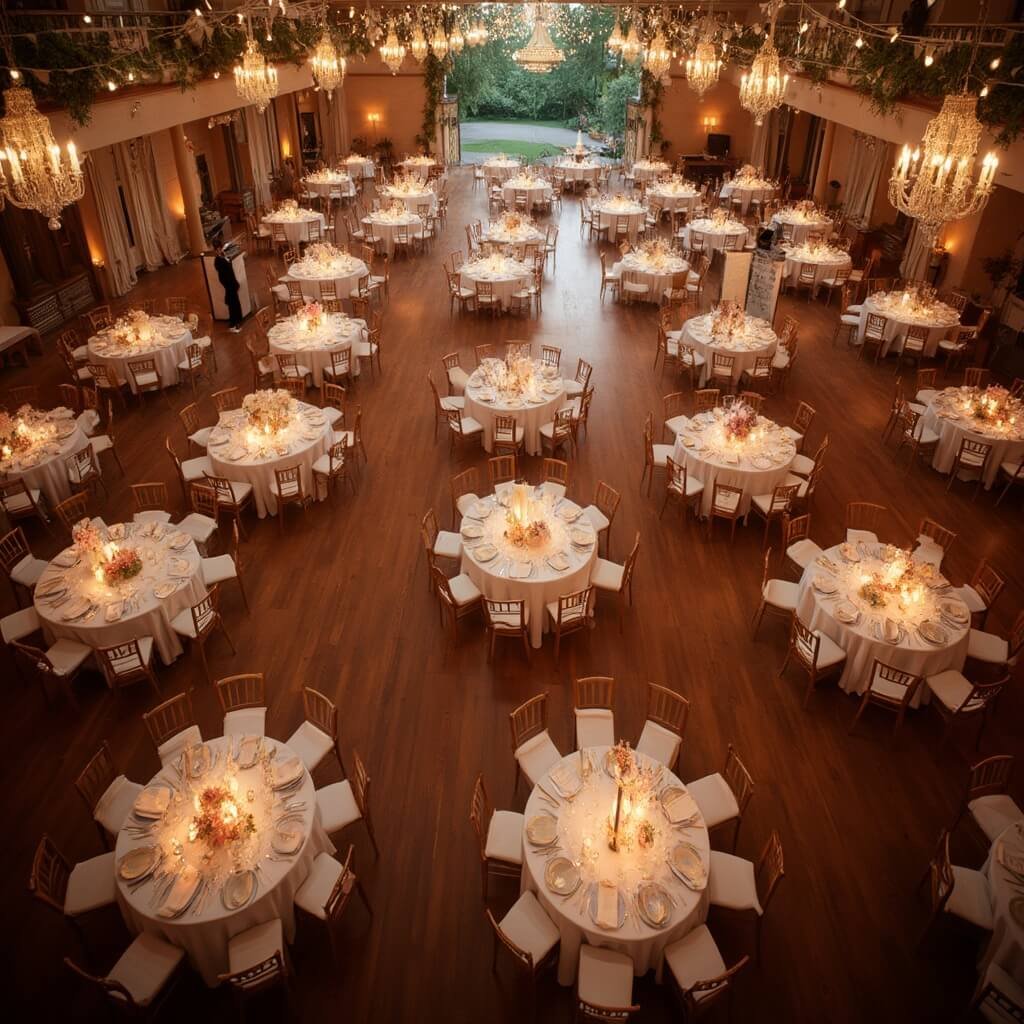
Table size sorted, the next problem is spacing — and this is where I see even experienced planners get caught out, because it’s invisible until it isn’t. A rough planning figure is 60 inches of clearance between tables, though the real number depends on your chairs, your service style, and whatever your venue’s fire code or accessibility requirements demand. That clearance isn’t just about looking generous on paper. It’s the gap a server needs to carry a tray of plates without turning sideways, and the gap a guest in a wheelchair needs to actually get to their seat rather than being wedged at the end of a row.
Before you fix the layout, map every functional zone in the room: dance floor, band or DJ setup, bar, buffet or catering stations, restrooms, cake table, gift table, and any lounge or photo areas you’re planning. These aren’t decorative afterthoughts — they dictate where tables can’t go. I once watched a florist’s dream layout get entirely redrawn an hour before guests arrived because nobody had accounted for the swing of the double doors the catering staff needed for service. The tables looked perfect. They were also directly in the fire exit path.
Keep chair backs out of aisles, keep cables and candle stands away from anywhere people walk, and think hard about sightlines — can the majority of guests actually see the couple during speeches, or is there a six-foot floral tower sitting squarely in the way of table nine? A centerpiece that blocks the first dance is a design failure, however well it photographs in isolation.
When it comes to actually laying the tables out, you’ve got a few sensible options:
Save this article
Enter your email and we'll send it straight to your inbox.
- Uniform grid — rows of identical rounds, which reads as formal and tidy and suits symmetrical ballrooms particularly well
- Staggered layout — offsetting tables slightly breaks the monotony and tends to improve how people move through the room
- Mixed layout — combining 60-inch and 72-inch rounds with a rectangular family-style table or two, plus cocktail tables for the bar area
- Curved or clustered layout — linking rounds in staggered clusters, sometimes called caterpillar-style arrangements, is one of the more interesting directions I’ve seen gaining ground for 2026, and it genuinely changes how a room feels to walk into
None of these is objectively correct. A marquee with uneven ground wants a different approach than a symmetrical hotel ballroom, and your choice should follow the room, not a trend you saw online.
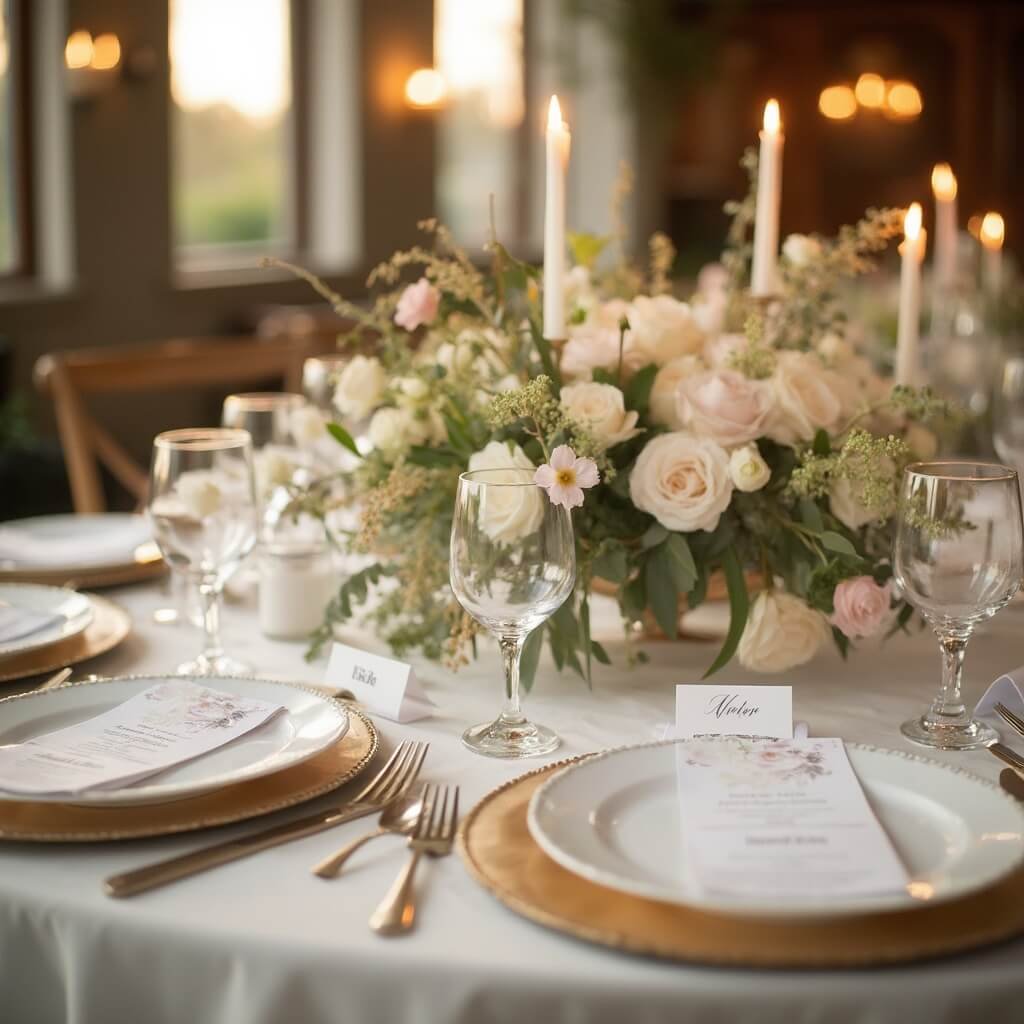
Settling on a Style and Palette Before You Buy Anything
I’d always rather a couple pick their style direction before they buy a single votive, because it saves money and arguments later. Classic and elegant leans on ivory linen, crystal, white flowers, and gold or silver accents — safe, timeless, occasionally a bit flat if nothing adds texture. Romantic garden styling goes looser: bud vases, trailing greenery, taper candles, soft linen that isn’t pressed to within an inch of its life. Rustic or farm-style brings in wood, stoneware, gauze, and flowers that look like they were cut from someone’s garden that morning, which they often were.
Modern minimalist is harder than it looks — monochromatic flowers and sculptural vessels only work if everything else on the table is equally restrained, because one fussy menu card undoes the whole effect. Glamorous and luxurious goes the other way entirely: velvet, metallics, mirrored surfaces, tall floral installations, dramatic lighting. Bohemian mixes vessels and textures deliberately, vintage glass next to woven mats next to coloured taper candles. Coastal or destination styling pulls from the location itself — sand tones, rattan, citrus, shell.
Whatever direction you pick, use the venue as your actual starting point rather than fighting it. If the carpet’s a deep burgundy and the chandeliers are brass, designing around a pastel palette is an uphill battle you don’t need to fight. Work with what’s already there.
Your palette should talk to the rest of the wedding — invitations, bridesmaid dresses, ceremony flowers, the cake, the signage, the lighting. I’d rather see a couple choose two colours and a metallic and commit properly than choose five colours and hope they blend. Neutrals let candlelight and texture do the work. Jewel tones are having a real moment for 2026, part of a broader shift toward richer, more layered palettes than the all-white, all-neutral weddings that dominated for the past several years. Seasonal colour choices — rust and amber in October, soft green and lilac in May — tend to feel more connected to the day itself than a palette imported wholesale from a mood board with no relationship to the time of year.
And here’s the thing I’d push back on hardest: don’t let trends do your thinking for you. A jewel-toned palette or a caterpillar table layout is only right if it suits you, your venue, and your guests — not because it’s what’s circulating this year. The better instinct, and the one I keep seeing among couples whose weddings actually feel like them, is reaching for personal meaning over imitation: grandmother’s china on the table, a runner made from a family member’s old sari, local wildflowers instead of imported blooms because that’s genuinely what grows where you live. Trends are a useful starting point. They’re a poor substitute for your own story.
Linens: The Layer Everyone Forgets to Budget For
Floor-length linen is the formal choice — it hides table legs, hides rental scuffs, and gives the whole room a finished look the moment it goes on. Standard-length cloths suit a more casual or rustic reception and they’re cheaper, which matters when you’re pricing out forty tables rather than four. Coloured linen gives you a strong base layer to build everything else on top of; patterned linen can work but needs restraint everywhere else on the table, or you end up with visual noise competing for attention with itself.
Runners add a tailored, layered look without the cost of switching the whole cloth. Run one vertically across a round table and it creates a visual line straight to the centerpiece — a small trick, but it works. Multiple narrow runners in slightly different textures can do more for a table’s depth than one expensive centerpiece ever will. Overlays in gauze, velvet, lace, or macramé bring in texture cheaply, and they’re often the detail that makes a table photograph well even when the flowers are modest.
Placemats deserve more credit than they get. Woven rattan, bamboo, linen, even cork — they give you a defined, structured anchor for each place setting without needing to lean on flowers to do that job. I’ve actually started recommending them more to couples working with tighter floral budgets, because a well-chosen placemat under a simple charger does a surprising amount of visual work on its own, and it’s one of the more sensible tabletop trends going into 2026 for exactly that reason.
The unglamorous bit: confirm your rental company’s actual measurements before you order, ask whether they press and install the linen themselves or drop it off in a box for you to deal with on the morning, and if you’re outdoors, plan for wind and damp. I’ve seen a beautiful ivory linen ruined by grass stains within twenty minutes of an outdoor reception starting, simply because nobody weighted it down. Clips and weights aren’t glamorous, but neither is a muddy tablecloth in your wedding photos.
Sizing Centerpieces for Round Tables
Centerpieces: Working Out What Actually Fits
Before choosing a single flower, measure what’s left on the table once the chargers, plates, glassware, flatware, and menus are in place. On a 60-inch round, that usually leaves room for a centerpiece base around 10 to 14 inches wide if you want guests to still reach their bread plate without diplomacy. As a rough guide, a centerpiece shouldn’t eat more than about a quarter of the table’s surface — much beyond that and you’re designing for the photograph, not the dinner.
Low arrangements are the safest choice for conversation and sightlines, and they suit almost every style from rustic to formal. Compote arrangements — loose, asymmetrical, slightly overflowing their vessel — give a garden feel without height getting in the way. Meadow-style centerpieces, where flowers and candles seem to grow naturally across the table rather than sitting in an obvious container, are very much where floral styling is heading; it’s a more relaxed, less “arranged” look than the structured designs that dominated weddings a decade ago. Wreaths work well framing a cluster of candles or a single vase, and they’re often cheaper than they look.
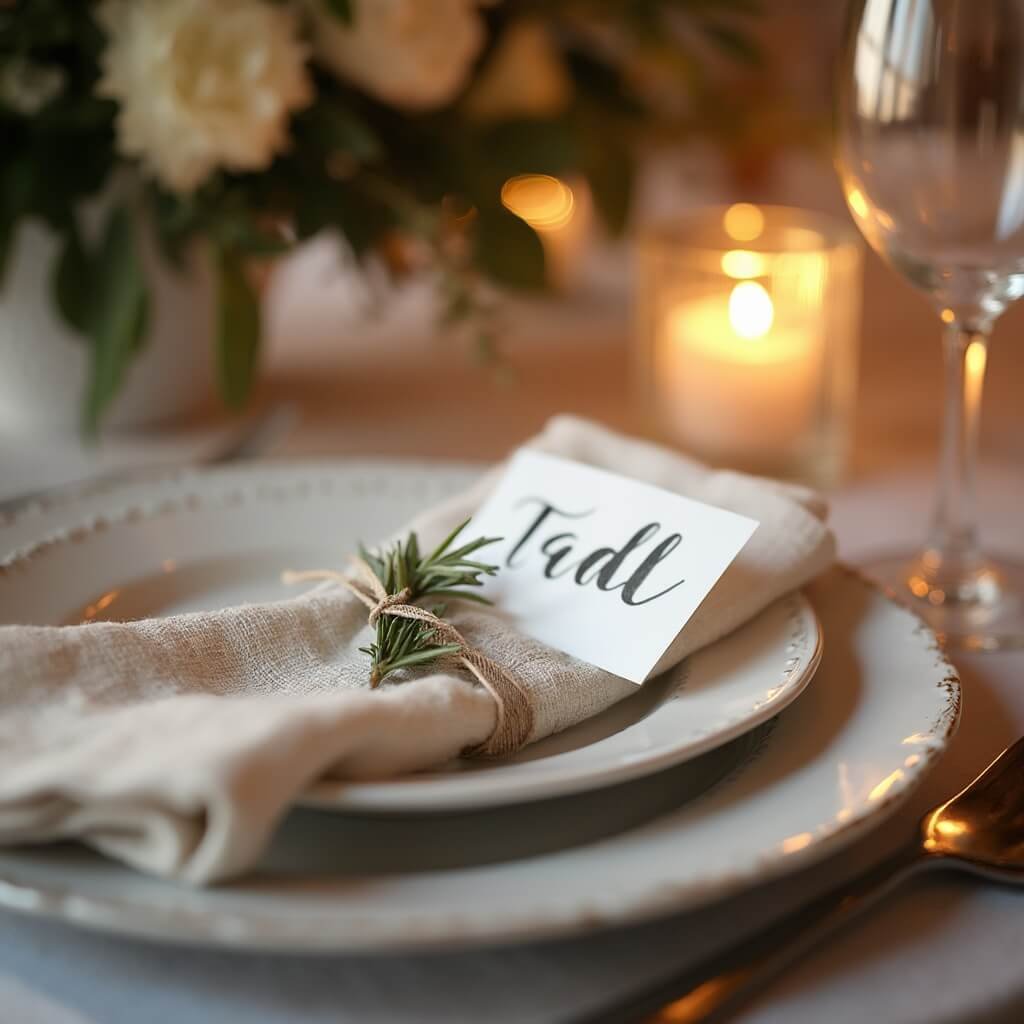
Low arrangements travel well, repurpose easily, and generally take less time to install — all real advantages on a wedding morning when everyone’s behind schedule. Their one failing is scale: in a large ballroom with high ceilings, a low arrangement can look a bit lost unless the room’s lighting and other decor compensate.
Tall centerpieces solve that problem but introduce several of their own. Trumpet vases, candelabras, and pedestal stands work brilliantly in rooms with real height, and they read as properly formal in a way low arrangements can’t quite manage. The planning rule I use is to keep arrangements either under about 14 inches or over about 24 inches — anything in between tends to sit at exactly guest eye level and block the view across the table, which defeats the entire point of choosing a round table in the first place. Tall arrangements cost more, travel badly, and need genuinely stable vessels — I’ve seen a candelabra go over because nobody checked the venue’s floor wasn’t quite level, which is not a mess you want happening mid-reception.
Bud vases are the compromise I recommend most often to couples trying to balance cost against visual interest. Cluster three to six small vases together, one or two stems each, mixed with votives or a small table number, and you get a relaxed, collected-over-time look for a fraction of what one large arrangement costs. The only real risk is a scattered, unintentional appearance if they’re not grouped with care — and small vases on a table full of gesturing hands do occasionally get knocked over, so I’d keep them away from the table edge.
Candles deserve their own consideration regardless of what else is on the table. Tapers read formal and add height without bulk. Votives give a gentler, more sociable glow. Pillar candles suit minimalist settings where you want a strong shape rather than scattered light. Always check your venue’s restrictions before you commit to open flame — plenty of historic buildings and marquees simply won’t allow it, and LED alternatives have got good enough now that I wouldn’t rule them out even where real candles are permitted.
And flowers aren’t compulsory. Fruit — citrus, figs, grapes, pomegranates — brings colour and a sense of seasonal abundance at a fraction of the cost of flowers, and it looks genuinely striking piled loosely down the centre of a table. Books, framed photographs, lanterns, potted herbs, or small objects tied to the couple’s story can replace a traditional centerpiece entirely, and often end up being the detail guests actually ask about.
My honest recommendation, after sitting through enough of these conversations to have a firm view: start with your table’s real usable space, not your Pinterest board, and build the centerpiece to fit the gap that’s actually left. Round table wedding decor succeeds or fails on that one unglamorous measurement far more often than it does on the flowers themselves.
bud vase centerpiece ideas for round tables
fall wedding centerpiece inspiration
wedding reception decor ideas
rustic wedding seating arrangement ideas
elegant napkin table setting ideas
👇Shop the Look here 👇
Want to keep this one?
We'll email you the link so you can find it again later.