What Does “Luxury Wedding Decor” Actually Mean?
Luxury wedding decor is one of those phrases that gets thrown around so often it’s almost lost its meaning. Couples come to me saying they want a “luxury feel” and when I ask what that looks like, half the time they describe something expensive rather than something considered. Those aren’t the same thing.
Real luxury in wedding styling isn’t about how much you spend. It’s about intentional design — every florals choice, every linen, every light fixture doing a job within a bigger picture, rather than existing because it looked nice on a moodboard. A single oversized floral installation over the top table will read as far more luxurious than twelve small centerpieces bought because they were on sale. Quality over quantity isn’t just a nice phrase here; it’s the entire operating principle.
Intentional Design Versus Expensive-Looking Design
There’s a real distinction between decor that’s genuinely luxurious and decor that’s simply expensive-looking, and I think couples conflate the two more than any other mistake I see in planning. Expensive-looking decor throws money at every surface — gold everywhere, crystal everywhere, flowers everywhere. Genuinely luxurious decor is restrained. It has a point of view. Someone made decisions about what not to include, which is honestly the harder skill.
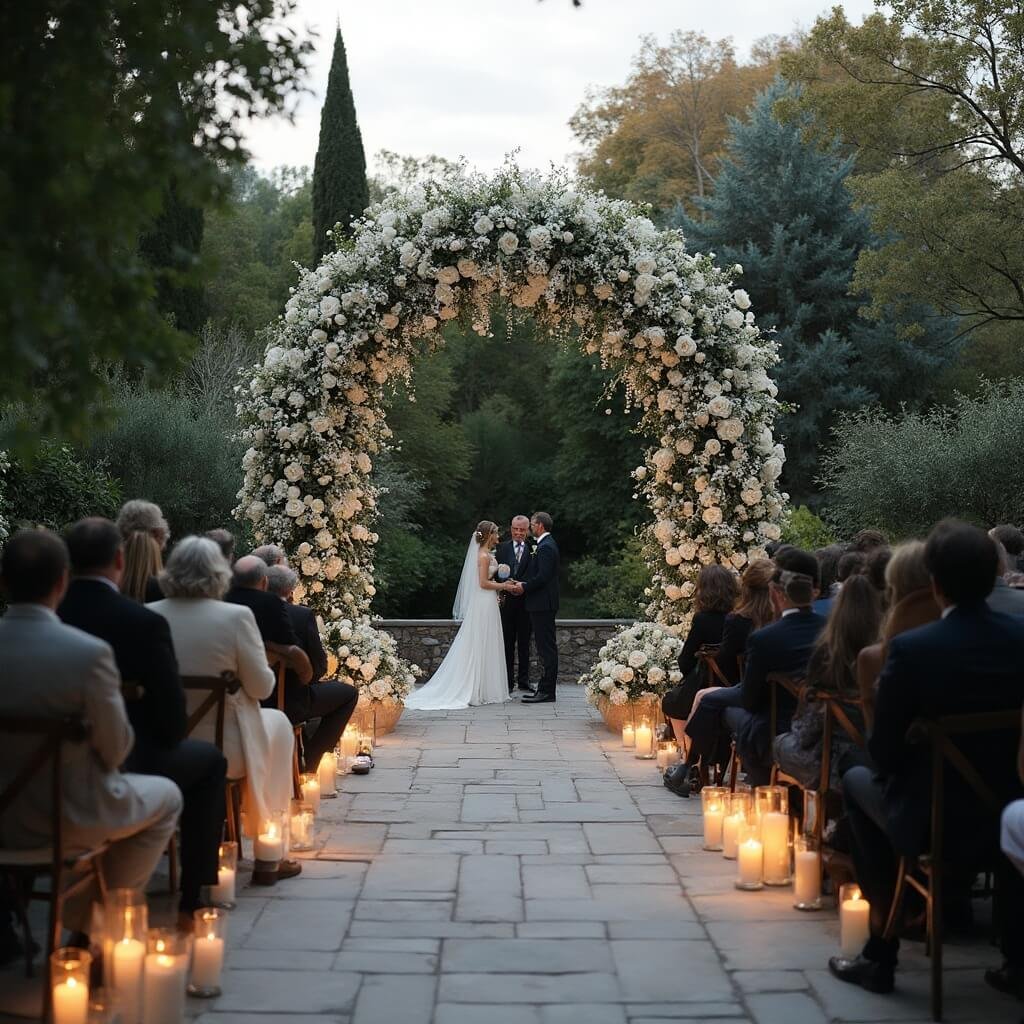
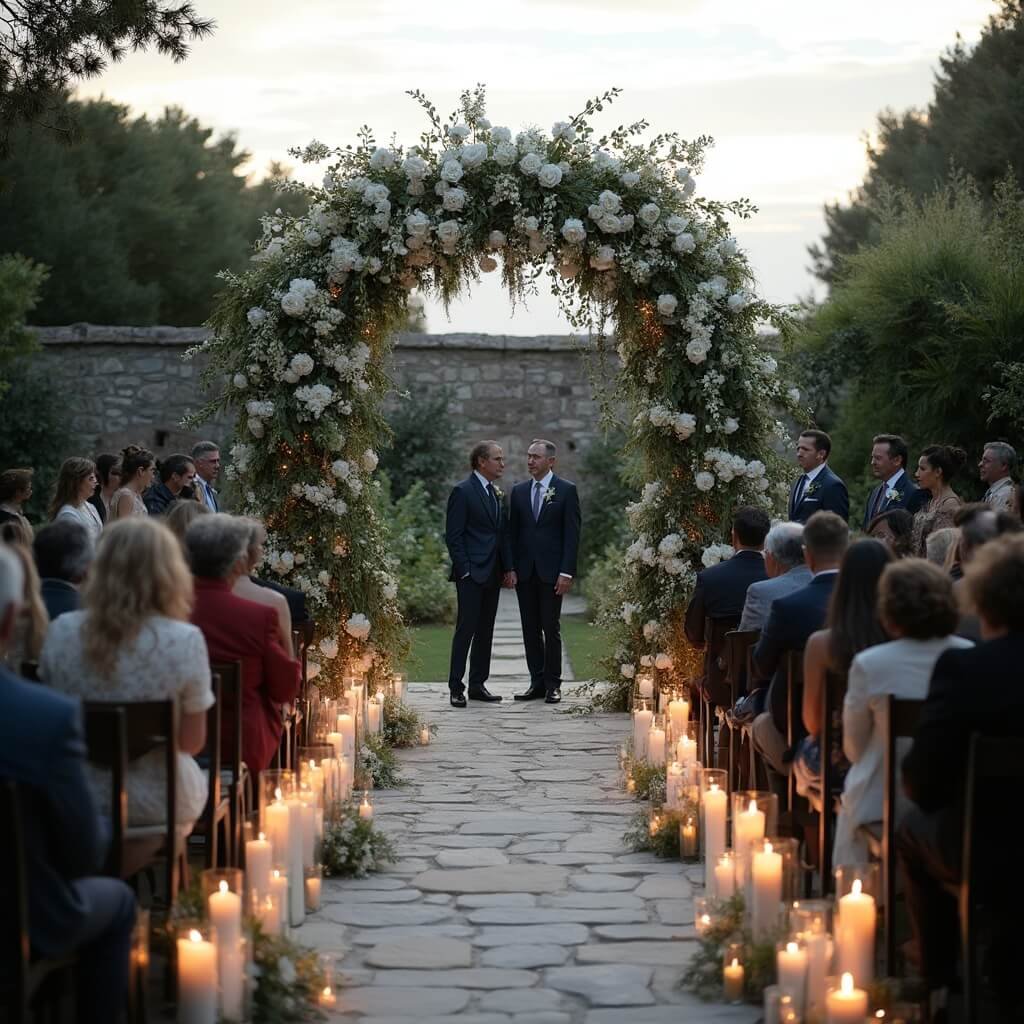
I officiated a wedding a couple of years back where the couple had one enormous arch of white roses and trailing jasmine at the ceremony, nothing else — no aisle decor, no petals, just two long runs of unlit candles either side of a stone path as the light faded. It was late September, about 6pm, and the temperature had dropped enough that guests were pulling on jackets. That single arch, against a fairly plain walled garden, looked more considered than anything I’d seen with triple the budget. Nobody was distracted. Everyone looked at the couple.
Luxury Decor Versus Standard Wedding Decor
Standard wedding decor tends to be additive — you buy a package, you add fairy lights, you add a runner, you add signage, and it accumulates into “nice.” Luxury decor is spatial. It treats the entire venue, ceiling included, as one canvas to be styled cohesively, with lighting, textiles, florals and furniture working together rather than being selected as separate line items on a supplier list.
The other difference is guest experience. Standard decor is often designed to be photographed. Luxury decor is designed to be felt — the comfort of a lounge area with proper furniture rather than hired plastic chairs, the warmth of layered candlelight rather than one string of festoon lights, fabric that guests instinctively want to touch. That shift from visual-only to sensory is, I think, the clearest marker of the genuinely high-end weddings I’ve worked.
Quiet Luxury or Maximalist Luxury — Which Suits You?
There are broadly two directions luxury decor takes at the moment, and neither is more “correct” than the other, whatever certain wedding blogs might imply.
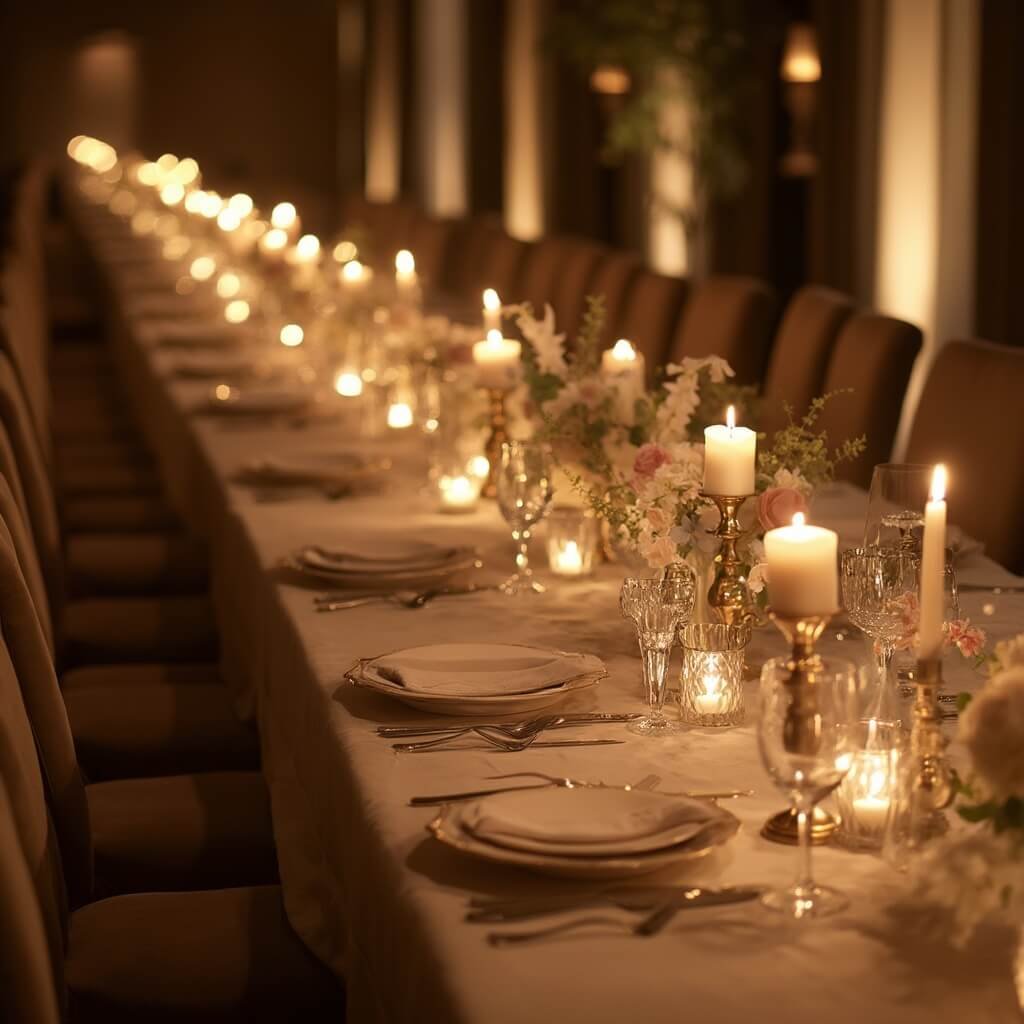
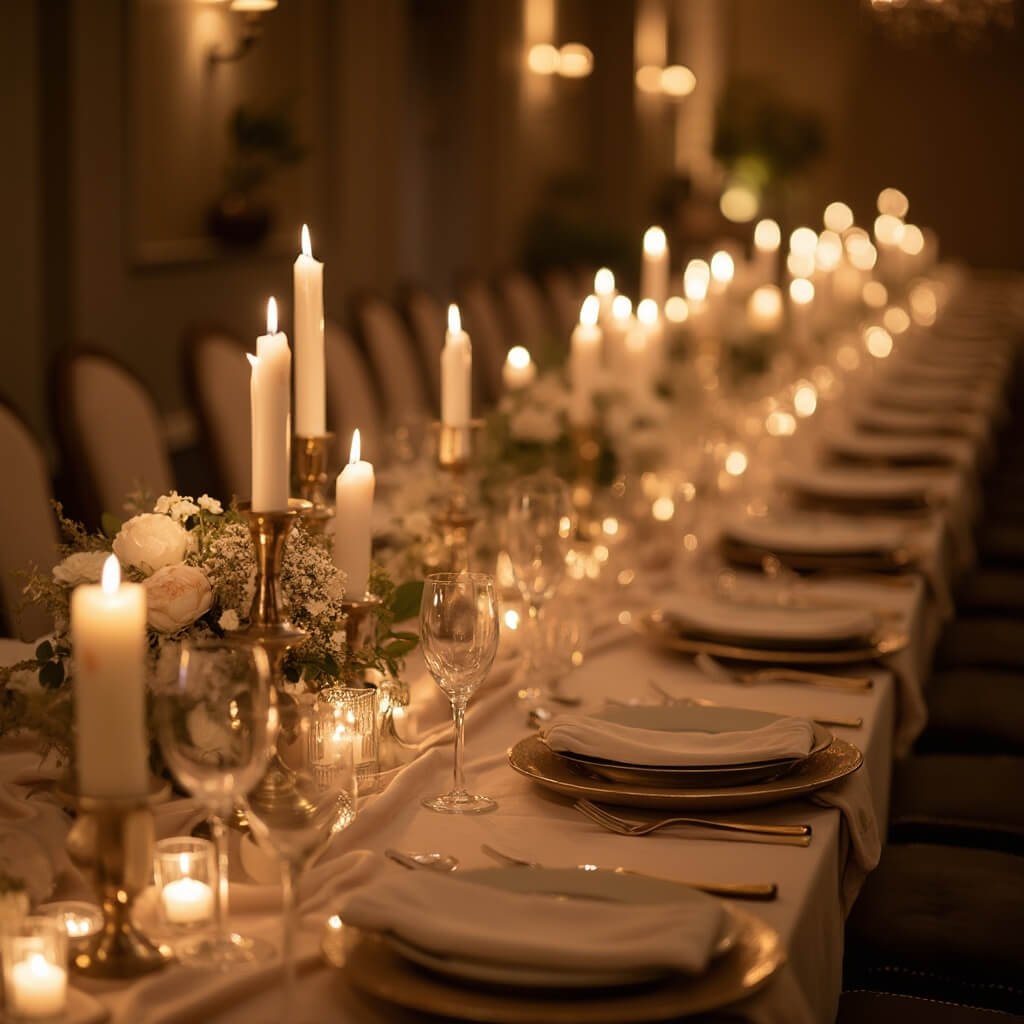
Quiet luxury leans on restraint: neutral or tonal palettes, clean lines, rich fabric rather than heavy ornamentation, and lighting doing most of the emotional work. Think a candlelit room in champagne and stone tones, minimal florals, beautiful linen. It photographs quietly but feels enormously expensive in the room.
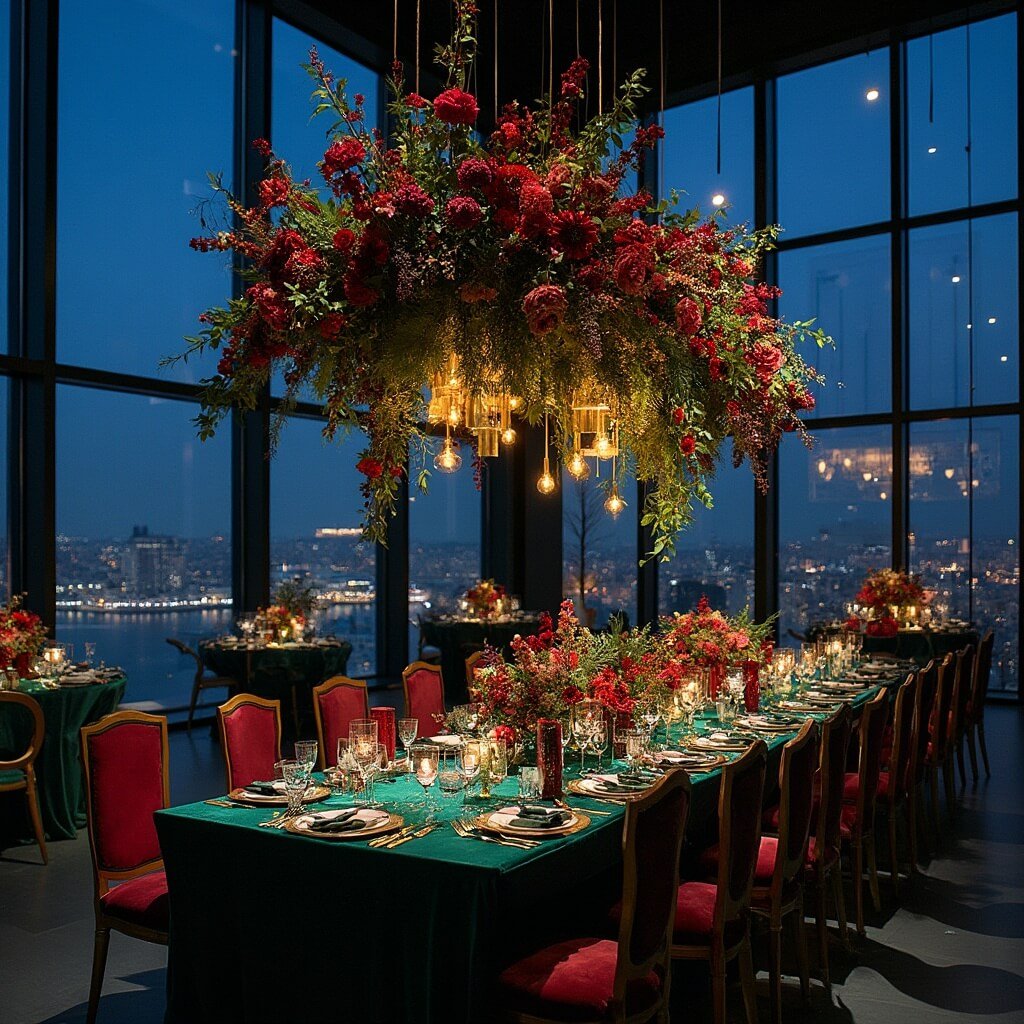
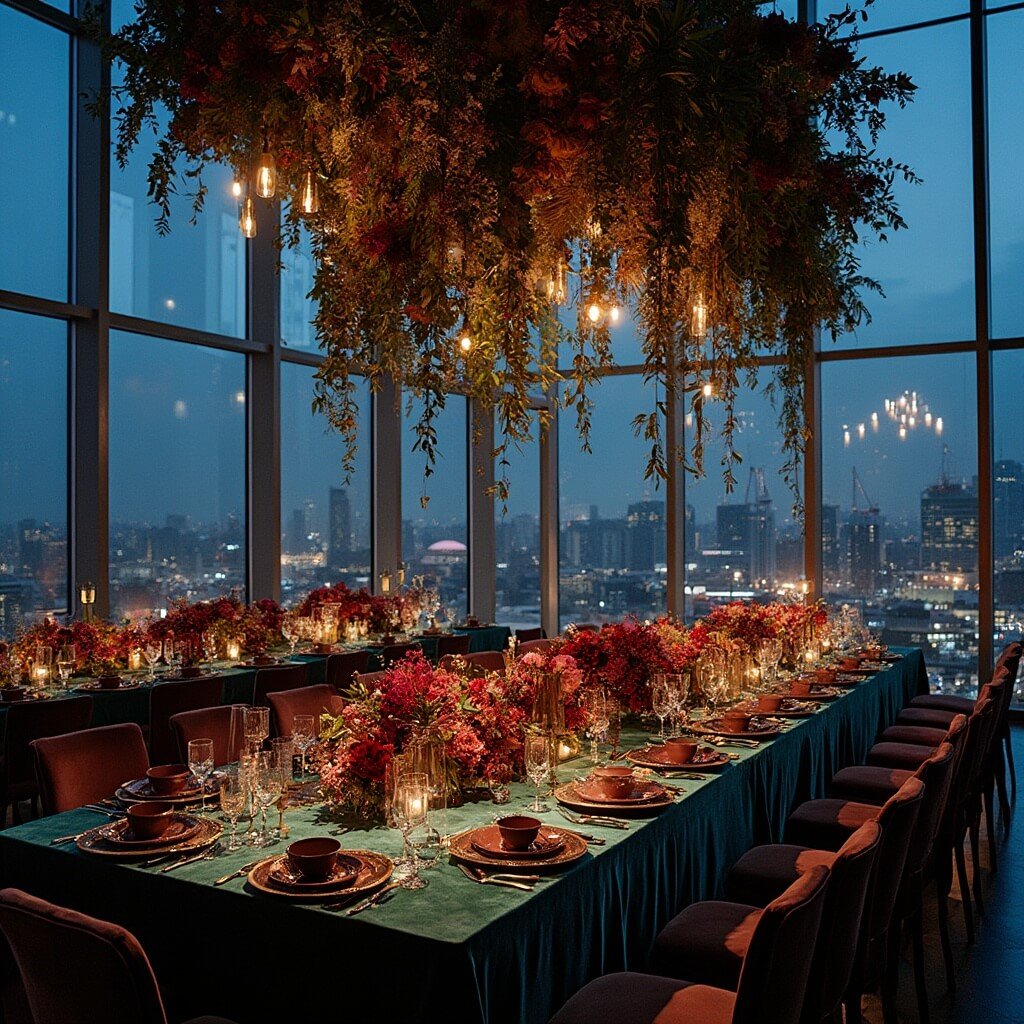
Maximalist luxury goes the other way — bold jewel-toned palettes, sculptural florals that verge on art installations, dramatic statement pieces. This suits couples with a strong aesthetic point of view and, often, a venue that can hold that kind of drama without feeling cluttered.
Choosing between them genuinely comes down to personality and venue. A minimalist glass-box venue can carry maximalist florals beautifully because the architecture itself is quiet. A heavily decorated historic hall, on the other hand, often wants the quieter palette so the two don’t fight each other.
The Five Pillars That Actually Define Luxury Styling
If I had to boil it down, luxury decor consistently rests on five things:
- Intentional design — every element supports one creative direction, nothing is there “because it’s trending”
- Colour harmony — a genuinely coordinated palette across florals, linens, stationery and lighting, not just a loose colour scheme
- Lighting elevation — treated as a design tool, not an afterthought, with multiple layers working together
- Texture layering — velvet, satin, ribbed glass and matte metal combined so tables feel as good as they look
- Quality over clutter — fewer, better pieces rather than a table groaning with small props
I’d say lighting is the one couples underestimate most. You can have extraordinary florals and beautiful tableware, but if the lighting is flat overhead venue lighting, none of it will read as luxurious in photos or in the room. Get the lighting wrong and everything else has to work twice as hard.
Building a Cohesive Design Story
The best luxury weddings I’ve stood at the front of all had a clear design story running through them — something that tied the ceremony to the drinks reception to the dinner to the evening. It might be inspired by the couple’s heritage, a particular era, or simply the architecture of the venue itself. A converted chapel with stone arches practically hands you an Old European aesthetic; fighting that instinct rarely pays off.
What matters more than the story itself is the continuity. The same palette, the same floral language, the same textures should carry through every space and every hour of the day. I’ve seen ceremonies with soft blush and ivory florals followed by a reception room done entirely in deep burgundy and gold — beautiful in isolation, but jarring as an experience, because it feels like two separate weddings rather than one considered day.
Repeating a motif helps enormously here too — a monogram, a particular floral variety, a specific candle style — appearing at the ceremony, again on the tables, again in the evening space. It’s a small thing, but it’s what makes a wedding feel designed rather than assembled.
For more insights on luxury wedding decor, explore our luxury wedding planning decor and luxury wedding decor ideas.
👇Shop the Look Here👇
Scale, Balance, and Knowing When to Stop
Proportion is where I see even well-funded weddings go wrong. There’s a temptation, once the budget allows for it, to make everything big — big arch, big centerpieces, big florals down every table — and the result is exhausting rather than impressive. The rooms that actually stop guests in the doorway are the ones that play with scale deliberately: one dramatic, oversized moment (a living ceiling, a floor-to-ceiling floral wall) balanced against long stretches of restraint elsewhere, low candle clusters, a plain runner, empty space on the table that isn’t “missing” anything.
That empty space matters more than people expect. Negative space is what makes a single sculptural centerpiece look like an art object rather than just a big flower arrangement. Fill every inch of a table and nothing gets to be the focal point, because everything is competing for attention at once. I always tell couples that a table which looks slightly underdressed in photos taken an hour before guests arrive is usually about right — once glassware, candles and place settings go on, it fills in exactly enough.
Colour Strategy: What’s Actually Being Chosen Right Now
Palettes have shifted noticeably over the past couple of years, away from the blush-and-eucalyptus default that dominated for so long. What I’m seeing booked for 2025 and into 2026 leans much richer:
Save this article
Enter your email and we'll send it straight to your inbox.
- Jewel tones — emerald, sapphire, plum, aubergine — used with real confidence rather than as a single accent
- Warm neutrals and earthy shades — olive, rust, burnt gold, champagne — for couples wanting something softer but still layered
- Cobalt blue and chocolate brown appearing as fashion-forward accent choices, often paired with metallics rather than florals alone
Metallics have swung back towards cooler tones too. Silver, stainless steel, and brushed inox finishes are turning up on flatware and vessels where gold would automatically have been chosen five years ago. It’s not that gold has disappeared — rose gold and bronze still suit a classic glam wedding perfectly well — but the automatic default has loosened, and couples are choosing metal finish based on the actual palette rather than habit.
What ties all of this together, regardless of which palette a couple picks, is that the colour has to appear in more than one place to register as intentional. A jewel-toned palette that only shows up in the bridesmaids’ dresses reads as coincidence. The same palette repeated in linens, candle glass, floral accents and stationery reads as design.
Ceremony Decor: Where the First Impression Happens
The ceremony space gets less budget than the reception in most weddings I work on, which has always struck me as backwards, because it’s the one moment every single guest experiences at the same time, looking the same direction, with nothing else competing for attention.
Entrances set the tone before anyone’s even sat down. Floral arches remain the obvious choice, but the more memorable versions I’ve seen recently ditch the single flat arch in favour of something with more depth — cascading roses mixed with trailing wisteria, or a narrow tunnel of blooms guests walk through rather than past. Low floral “meadows” along the aisle edges, rather than tall pedestal arrangements, create a gentler, more immersive feel and tend to photograph beautifully at a guest’s eye level, which pedestals rarely do.
Seating deserves more thought than it usually gets too. Chairs left completely bare can look fine in a grand room with strong architecture, but a simple fabric drape or small floral cluster on aisle-facing chairs adds cohesion for very little cost. I’ve also started seeing more curved or serpentine ceremony seating instead of strict rows — it’s a small adjustment that makes the whole gathering feel more like a circle around the couple than an audience facing a stage, which changes the atmosphere more than you’d expect from something so simple.
The altar or backdrop is obviously the visual anchor, and the best ones I’ve stood at now tend to surround the couple rather than sit flat behind them — an arch with depth, or a semicircle of florals and greenery that guests feel enclosed by. Materials matter here too: a clean structural frame in metal or acrylic softened with loose, asymmetrical florals reads as far more current than a fully floral-covered arch, which can start to look heavy and dated.
It’s worth remembering the ceremony isn’t only visual. I’ve noticed couples paying closer attention to sound — a cellist rather than a generic playlist, chosen specifically because it suits the aesthetic rather than because it’s a popular first-dance-adjacent song — and to scent, with fragrant florals like garden roses or jasmine placed carefully near the altar but kept away from guests seated in the first couple of rows, since a heavy scent at close range can be overwhelming rather than romantic.
Reception Rooms as a Single Canvas
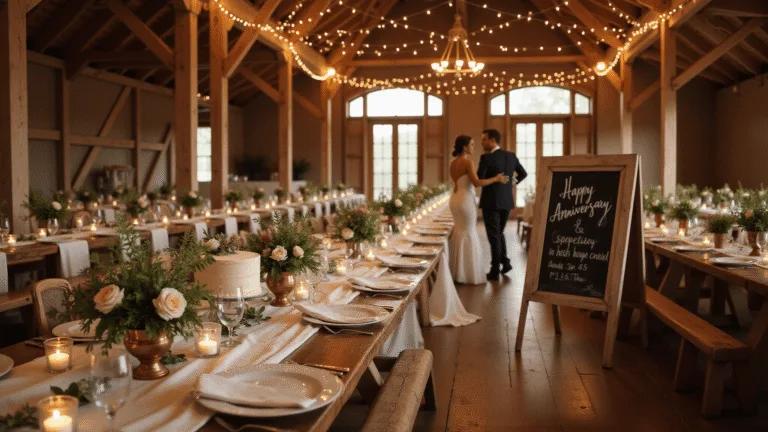
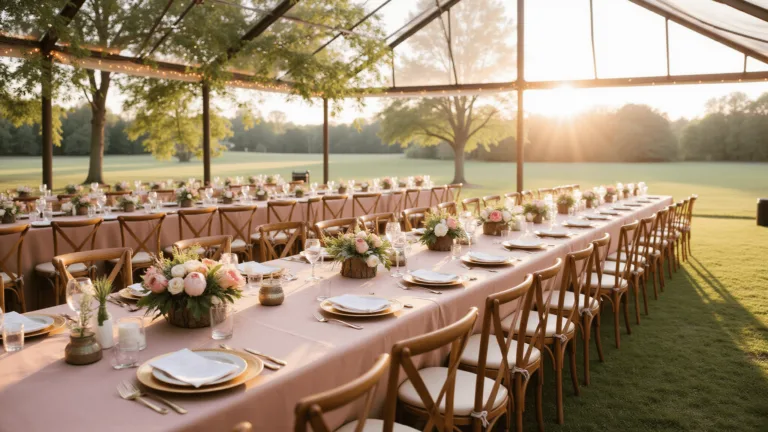
Once guests move into the reception space, the room itself needs to be treated as one composition rather than a collection of tables. The strongest examples I’ve seen use the ceiling as much as the floor — a suspended installation of greenery and candles, or a botanical “cloud” above the dance floor — so that looking up is as rewarding as looking at the table in front of you. Serpentine table layouts, rather than the standard grid of round tables, also help enormously with this sense of one continuous design rather than repeated identical units.
Lounge areas around the edges of a reception, once an afterthought with a couple of hired sofas, have become one of the clearer markers of a well-styled wedding. Proper furniture, low lighting, a side table with real books or a vase rather than a plastic centrepiece — it signals that someone thought about where guests would go to sit down and talk once dinner’s finished, rather than assuming everyone stays glued to their assigned seat all night.
Tablescapes: Where Most of the Budget Shows
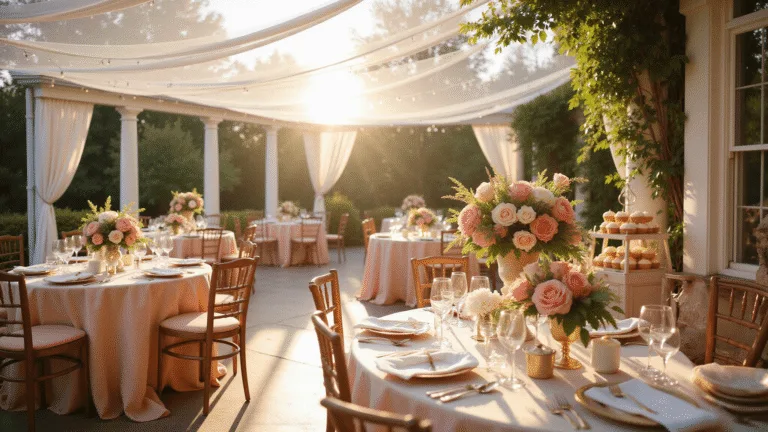
The table is still where guests spend the most time looking closely at decor, and it’s where texture layering earns its reputation as the defining trait of luxury styling right now. Velvet runners under jacquard placemats, satin napkins against ribbed glassware, a mix of matte and polished metal finishes on the same setting — none of this is about matching, it’s about creating enough tactile variety that a guest’s hand wants to rest on the table rather than just their eyes taking it in.
Centerpieces have diversified too. Tall glass vessels with trailing greenery still work well for formal rooms, but I’m seeing more mixed-height arrangements now — a low, lush floral runner interrupted by clusters of varying candle heights rather than one uniform centerpiece repeated down every table. There’s also a genuinely interesting trend towards centerpieces that aren’t florals at all: bowls of seasonal fruit, vintage silver platters styled almost like a still-life painting, objects that feel collected rather than ordered from a catalogue.
Stationery and place settings have become far more personal as a result. Hand-lettered menus, embroidered napkins with a couple’s initials, heirloom-style monograms that look like they’ve been in the family for generations rather than designed last month on a laptop — these small, tactile touches are often what guests remember and comment on, more than the size of the floral arch ever gets mentioned back to me afterwards.
Florals as Sculpture, Not Arrangement
The single biggest shift I’ve watched happen in floral design over the last few years is the move away from symmetrical, rounded arrangements towards something closer to sculpture. Asymmetrical shapes, deliberate gaps, single-variety installations sculpted into bold architectural forms — florals are increasingly designed to be looked at the way you’d look at an art piece, with intentional negative space rather than density for its own sake.
This has produced some genuinely striking installations: suspended floral “clouds” above dining tables, cascading living ceilings, entire botanical walls that double as photo backdrops and interactive decor. At the more grounded end, lush garden-style arrangements — overflowing hydrangeas, garden roses, loose foliage that looks almost untamed — remain popular for couples who want richness without going fully architectural.
Sustainability has quietly become part of this conversation too, and I think it’s overdue. Foam-free mechanics, preserved flowers, and structures designed to be reused between ceremony and reception rather than built twice are becoming standard practice among florists I respect, not a marketing add-on. A ceremony arch that gets dismantled and repositioned behind the top table for the reception isn’t a compromise — done well, it’s actually smarter design, because it reinforces that visual continuity I mentioned earlier rather than starting from scratch.
Lighting: The Detail That Changes Everything
I said earlier that lighting is the pillar couples underestimate most, and it’s worth returning to because it’s genuinely the difference between a room that looks styled and one that looks merely decorated. Statement chandeliers — whether hired crystal pieces or custom-built installations mixed with trailing florals — have become one of the defining choices for 2025 and 2026 weddings I’m seeing booked, precisely because they do double duty as both light source and centerpiece.
Beneath that statement layer, it’s the smaller lighting decisions that do the emotional work: candlelit pathways, pin-spot lighting angled onto centerpieces rather than flooding the whole table, warm accent lighting washing up walls rather than harsh downlighting from the venue’s existing fixtures. Custom gobo lighting projecting a monogram onto a dance floor or wall is a lovely, understated touch too, and considerably cheaper than most couples assume.
A Practical Next Step
If you’re planning this yourself rather than working with a designer, my honest advice is to spend disproportionately on lighting and one hero floral moment before anything else, because those two elements do more to create a genuinely luxurious atmosphere than a dozen smaller decorative touches ever will. Visit your venue at the time of day your ceremony or reception will actually happen, watch how the natural light behaves, and build your lighting plan around that reality rather than a Pinterest board shot in different conditions entirely. Luxury wedding decor, done properly, isn’t about the size of the spend — it’s about that one clear decision, followed through consistently, that makes a room feel considered rather than simply furnished.
For more inspiration on achieving luxury decor for your wedding, consider browsing through our luxury black and gold party styling inspiration, or explore luxe glam terrace wedding styling for more ideas.
👇Shop the Look here 👇
Want to keep this one?
We'll email you the link so you can find it again later.