Judy Garland and The Wizard of Oz: The Role That Changed Everything
Who Was Dorothy Gale — And Why Did Judy Garland Get the Part?
Here’s something that surprises a lot of people.
Judy Garland was not the first choice for Dorothy.
MGM had its eye on Shirley Temple, who was arguably the biggest child star in Hollywood at the time. But contractual complications between studios got in the way, and creative decisions shifted the direction of the casting entirely.
That left the door wide open for Garland.
She was 16 years old when she was cast — older than L. Frank Baum had originally written Dorothy in his 1900 novel The Wonderful Wizard of Oz. The studio knew this. And they dealt with it in ways that were, frankly, pretty troubling (more on that in a minute).
But despite all of it, Garland stepped into those ruby red slippers and made Dorothy completely her own.
“Over the Rainbow” — The Song That Became Her Whole Identity
If you’ve ever heard “Over the Rainbow” played at a wedding, a funeral, or hummed softly by a stranger on the street, you already understand its power.
Harold Arlen wrote the music. Yip Harburg wrote the lyrics. Both wrote it specifically for this film.
And Judy Garland sang it in a way that made it feel like it had always existed.
Here’s what’s wild though — the song almost didn’t make it into the final cut.
Studio executives thought it slowed the film down. They wanted it removed. It stayed. And it went on to win the Academy Award for Best Original Song at the 1940 Oscars.
Garland herself later said it was her favorite song. She sang it throughout her entire concert career, right up until the end of her life.
It wasn’t just a song to her. It was a piece of her soul.
What The Wizard of Oz Did For Judy Garland’s Career
Before 1939, Garland was a talented young performer with a bright future.
After 1939, she was a global superstar.
The film based on Baum’s novel — Dorothy Gale, a Kansas farm girl swept away to the magical Land of Oz — became one of the most beloved movies in history.
And Garland was at the center of all of it.
Her portrayal was credited with building her image as the quintessential “plucky” American girl. Relatable, warm, brave, and real.
The recognition was official too. At the same 1940 Academy Awards ceremony where “Over the Rainbow” took home Best Original Song, Garland received a special Academy Juvenile Award for her outstanding performances that year.
Save this article
Enter your email and we'll send it straight to your inbox.
The Wizard of Oz was the crown jewel of that recognition.

The Dark Side of the Yellow Brick Road
I want to be honest about something here, because glossing over it would do Garland a disservice.
The production of The Wizard of Oz was not a magical experience for the young woman at its center.
Principal photography ran from October 1938 to March 1939 — a grueling 23-week shoot.
During that time, Garland worked under conditions that today would be considered completely unacceptable:
- Wardrobe measures were used to make her appear younger and smaller than she was
- She faced intense pressure around her appearance and weight throughout filming
- The studio environment was tightly controlled, leaving her little room to breathe, rest, or simply be a teenager
- Biographical accounts paint a picture of a young girl under enormous, relentless pressure
It’s impossible to watch her skip down that yellow brick road and not think about what was happening off-camera.
What she gave audiences was pure joy. What she experienced behind the scenes was something else entirely.
The Costume, The Slippers, and The Look That Never Gets Old
Let’s talk about the visual legacy for a second, because it’s genuinely remarkable.
More than 85 years later, you can show almost anyone in the world a picture of:
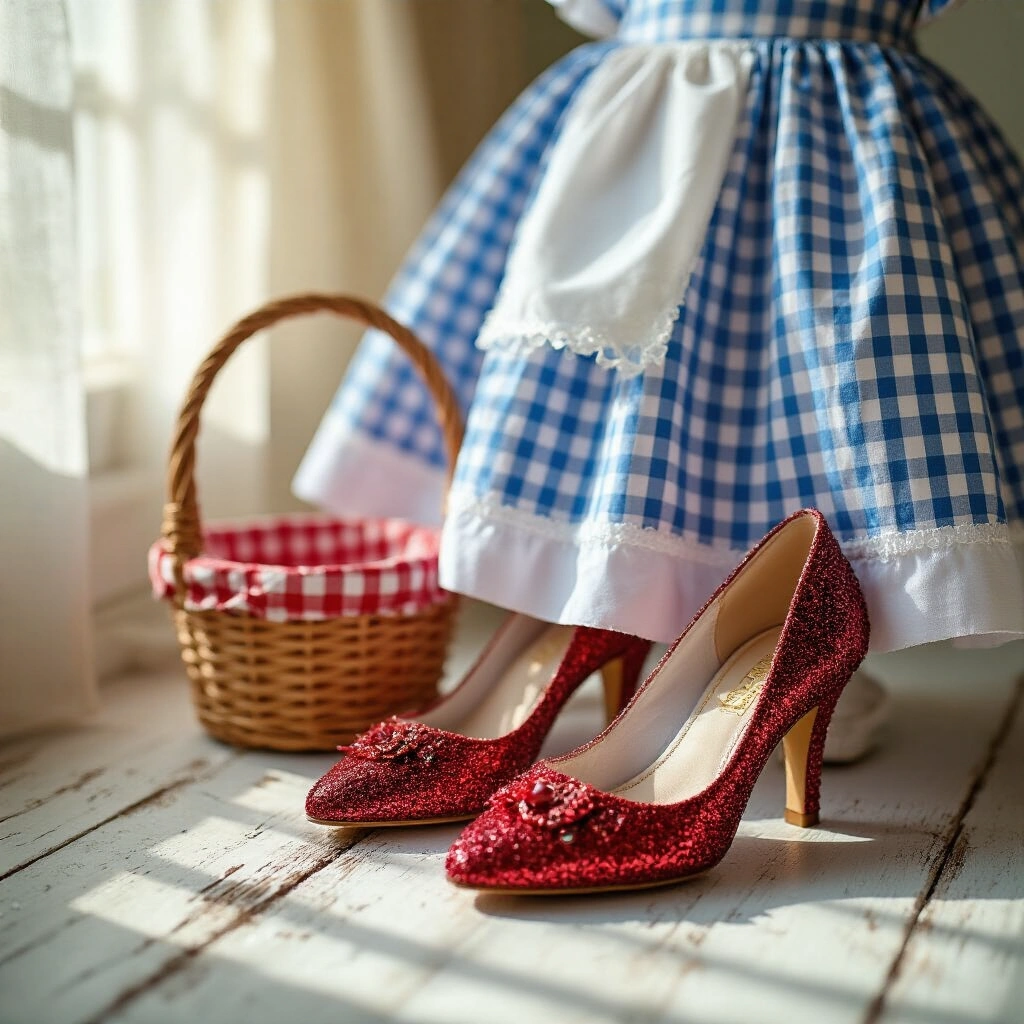
- A blue and white gingham dress
- A pair of sparkling ruby slippers
- A little black dog in a basket
- A girl with two braids looking up at the sky
And they will know exactly who that is.
That’s not just good costume design. That’s cultural mythology.
The blue gingham dress has become one of the most recognized costumes in film history. The ruby slippers have been auctioned for millions of dollars. And Toto — the little Cairn Terrier who played Dorothy’s faithful companion — has his own fan base to this day.
If you want to recreate the look for a costume event, you really only need three things:
- The gingham dress
- A pair of ruby slipper shoes
- A small wicker basket (Toto optional, but highly recommended)
Nobody is going to miss who you’re dressed as.
Why Dorothy Gale Still Matters in Popular Culture
Here’s the thing about truly iconic characters.
They don’t stay frozen in time. They grow with each new generation that discovers them.
Dorothy Gale has been re
Want to keep this one?
We'll email you the link so you can find it again later.