How to Style Garland Above Kitchen Cabinets Like a Pro
How to Style Garland Above Kitchen Cabinets Like a Pro
Garland above kitchen cabinets transforms dead space into a festive focal point, but I’ll be honest with you—most people get it completely wrong.
They buy pre-lit artificial garland, drape it up there, and wonder why it looks flat and sad like someone just gave up halfway through decorating.
I’ve styled dozens of kitchens for events and photo shoots, and the difference between “meh” and “magazine-worthy” comes down to technique, not budget.
Why Your Garland Looks Sad (And How to Fix It)
Walk into any kitchen in December and you’ll see the same problem. Sparse garland sitting limply on cabinet tops. No movement, no personality, just green stuff gathering dust.
The issue? Most people treat garland like it’s self-sufficient. It’s not.
Think of basic garland as the canvas, not the painting. You wouldn’t hang a blank canvas on your wall and call it art, would you?
The Installation Method That Actually Works
Forget placing garland flat on top of your cabinets.
That’s amateur hour.
Here’s what I do:
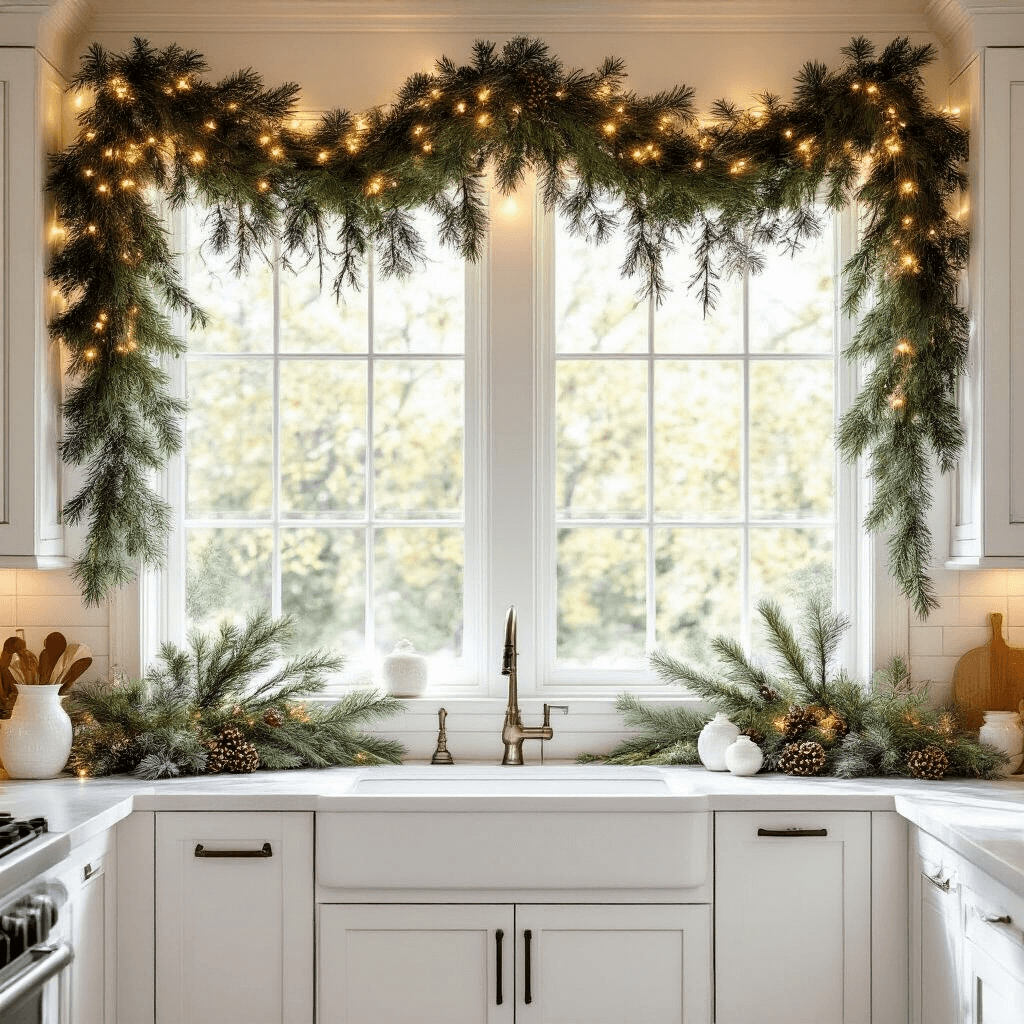
Hang it from the front edge of your cabinets so it cascades forward slightly. This creates dimension and lets people actually see your hard work from normal standing height.
What you’ll need:
- Clear adhesive hooks or small Command hooks
- Your garland (we’ll talk about choosing the right one)
- Fishing line or floral wire for securing
- A step ladder that doesn’t wobble
The process:
Place hooks every 18-24 inches along the top front edge of your cabinets. These should sit ON TOP where no one can see them.
Drape your garland from hook to hook, letting it swag naturally between each point. The swag creates visual rhythm.
Secure any wayward sections with fishing line tied to the hooks. This prevents the whole thing from sliding around every time someone opens a cabinet too enthusiastically.
Making Blank Garland Look Expensive
Here’s where the magic happens.
I never—and I mean NEVER—use garland straight from the package.
Layer in these elements:
Pine cones and berries Tuck artificial berry picks deep into the garland branches at varying intervals. Not symmetrical. Not evenly spaced. Nature doesn’t work that way.
Cluster three to five pine cones together in 2-3 spots along your garland length. Single pine cones look lost. Groups look intentional.
Additional greenery Buy mixed pine and eucalyptus stems separately. Weave them throughout your base garland to fill gaps and create texture variation.
The human eye craves texture. All one type of greenery reads as flat and boring.
Oversized elements at transitions Where your garland turns a corner or meets cabinet molding, go bigger. Add a cluster of larger branches, a bow, or an oversized ornament.
This signals to anyone looking that the transition is deliberate, not just where you ran out of steam.
The Lighting Game-Changer
Garland without lights is just greenery. Garland with lights becomes atmosphere.
My lighting formula:
For every foot of garland, plan for approximately 16-20 lights. So a 12-foot run needs about 200 small LED lights minimum.
Use warm white LED string lights with a thin wire. Thick wire shows through and looks clunky.
Weaving technique that hides the wire:
Start at your outlet end (plan this before you begin). Push the wire deep into the garland branches, going over and under different stems.
Never wrap the lights AROUND the garland like a candy cane stripe. That’s what amateurs do, and the wire becomes the feature instead of the light.
Add extra loops of lights at your transition points where you’ve clustered larger elements. More light there creates natural focal points.
Pro tip I learned the hard way: Test your lights BEFORE weaving them through. Nothing worse than finishing a beautiful garland and discovering half the strand is dead.

Creating Fullness Without Breaking the Bank
Expensive designer garland isn’t necessarily fuller than budget versions. The difference is in the styling.
My technique for maximum fullness:
Buy two types of garland in different shades of green or with different needle types. Twist them together as you install.
This immediately doubles your volume and creates depth that single garland can’t achieve.
Fill visible gaps with individual stems from the craft store. Just poke them into the garland wherever you see through to the cabinet.
Fluff like your life depends on it. Every single branch needs separating and positioning.
Set aside 20 minutes for this step. Put on music or a podcast. Go branch by branch, pulling them forward and positioning them at different angles.
This is tedious. This is also the difference between professional and amateur.
What Works for Different Kitchen Styles
Traditional kitchens: Go classic with mixed pine and red berry garland. Add pinecones and a few gold ornaments. Warm white lights.
Modern kitchens: Keep it simple with single-variety greenery like eucalyptus or plain pine. Cool white lights or skip lights entirely. Minimal additions—maybe some white berries or simple silver ornaments.
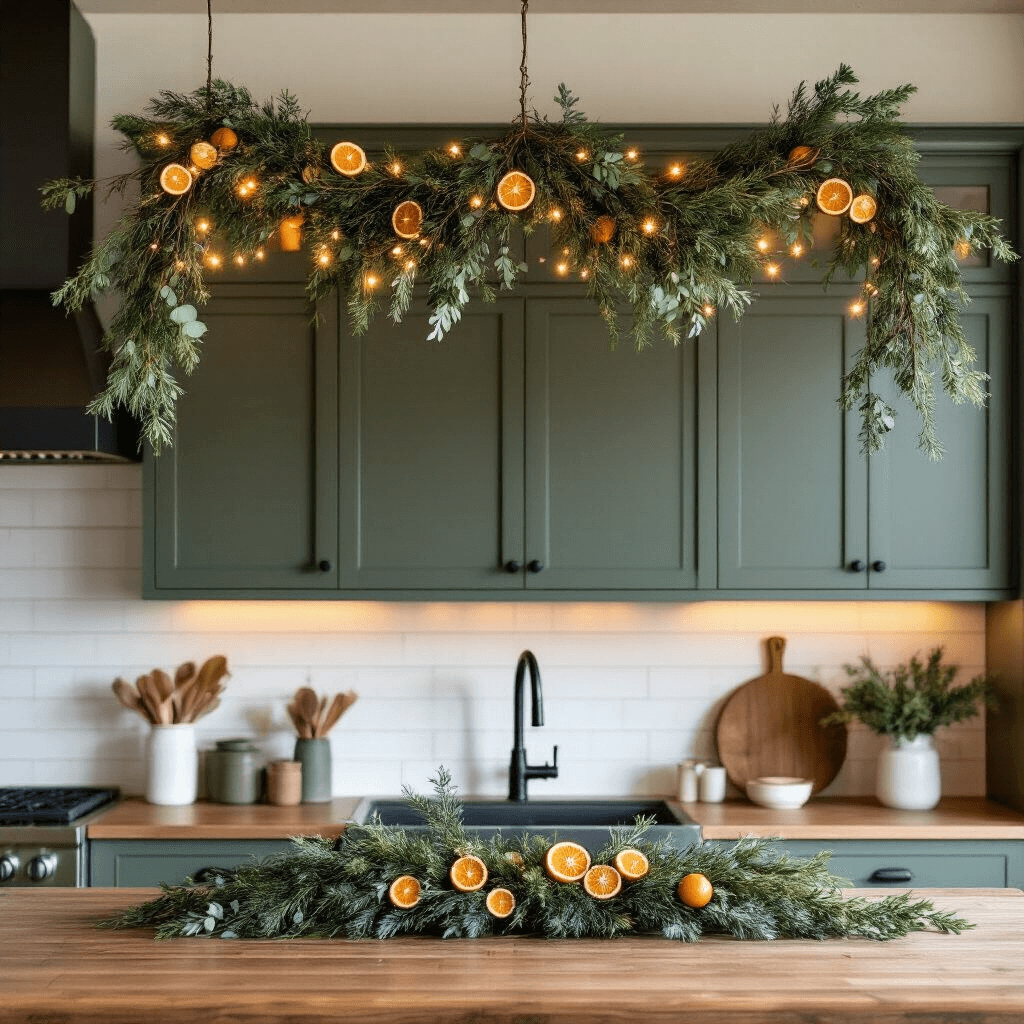
Farmhouse kitchens: Mix real and faux elements if you can. Incorporate dried orange slices, cinnamon sticks, and buffalo check ribbon. Go heavy on the texture, light on the color.
Coastal kitchens: Frost-tipped garland with silver and blue accents. White lights. Add some shell ornaments or starfish if you want to lean into the theme.
Common Mistakes That Ruin the Look
Using too-short garland for your space. Measure your cabinet run and add 30% to that length. The swag between hooks requires extra length.
Skipping the fluffing step. I cannot stress this enough. Unfluffed garland looks like you don’t care.
Symmetrical placement of decorative elements. Your kitchen isn’t a museum display. Randomize your berry clusters and ornament placement.
Ignoring the view from your kitchen doorway. Step back to where people actually see your kitchen from. Adjust accordingly.
Forgetting about cabinet access. If you open your cabinets from below, make sure your hanging garland doesn’t catch on doors. Ask me how